 keymodels
BHAG
How can bhag support strategic choice or positioning?
Contents
Every organisation benefits from a commonly understood, organisation-wide long-term goal.
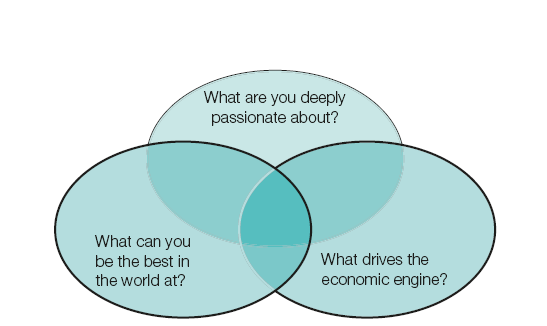
A shared long-term ambition can focus an entire organisation. James Collins and Jerry Porras called such an ambition a BHAG—a “big hairy audacious goal”—in Built to Last. A BHAG gives people one vivid destination beyond incremental improvement. When developing it alongside Collins’s later “hedgehog concept,” examine what the organisation cares deeply about, what it could become the best in the world at and what drives its economic engine. The intersection helps ground an inspiring future direction.
When to use it
Use a BHAG when the organisation needs a long-range destination that can align activity, guide decisions and motivate coordinated effort. It asks what the company’s next consequential leap should be and gives the organisation a purposeful, positive view of the future.
Origins
James C. Collins and Jerry I. Porras introduced the term in their 1994 book Built to Last, based on research into enduring “visionary” companies. Their nineteen ninety-six Harvard Business Review article “Building Your Company’s Vision” developed the idea further and distinguished a ten-to-thirty-year BHAG from an organisation’s enduring core ideology.
What it is
A Big Hairy Audacious Goal is a concrete, compelling ambition intended to focus and energise an organisation for many years. Collins and Porras describe four broad forms: a quantified target, the defeat of a common enemy, emulation of a role model and a major internal transformation. The goal should demand capabilities the organisation does not yet possess while remaining specific enough for people to know whether it has been accomplished.
How to use it
Develop the ambition by exploring three grounding questions:
- What are you deeply passionate about? Outstanding commitment is most credible where the work matters deeply to the organisation. Express this as a customer problem the company is determined to solve exceptionally well.
- What can you become the best in the world at? Look beyond a popular feature or current bestseller to the underlying competence the organisation could perform better than anyone else.
- What drives the economic engine? Identify the denominator that most strongly influences sustainable financial return, such as customers, billable hours or brand-price premium.
Answer the questions separately, compare the evidence and use their overlap to test candidate goals. Build a shared understanding before polishing the language. A memorable one-line formulation can help communication, but clarity of ambition matters more than a slogan.
Final analysis
The value lies both in the destination and in the discussion required to define it. Formulating a BHAG forces explicit consideration of the organisation’s raison d’être and can prompt a fundamental rethink of strategy or business model. A credible, exciting ambition can create fertile conditions for reinvention.
The work requires creativity and openness while options are being generated, followed by discipline when choices and commitments are made. It can easily deteriorate into a competition for impressive soundbites that avoids the organisation’s underlying realities.
Top practical tip
Generate several candidate ambitions, test each against passion, potential advantage and the economic engine, then ask what new capability and sustained commitment achievement would require.
Top pitfall
A memorable ambition is not a strategy. Without a credible basis, milestones and explicit choices about what the organisation will not do, a BHAG can legitimise wishful thinking or reckless commitment.
Further reading
Collins, J. and Porras, J. (1994) Built to Last: Successful Habits of Visionary Companies. HarperBusiness.
Collins, J. and Porras, J. (1996) ‘Building your company’s vision’. Harvard Business Review 74(5), 65–77.