 keymodels
Branding pentagram
How can branding pentagram support strategic choice or positioning?
Contents
The branding pentagram is a model that helps to translate corporate strategy into branding policy by stating the branding principles, ‘loading’ the brand, choosing the.
The branding pentagram translates corporate strategy into a managed brand system. It defines brand principles, selects a position, makes every brand carrier consistent, embeds the promise in daily behaviour and establishes a planning-and-control cycle.
When to use it
Use the framework to create, clarify or improve a brand by answering three basic customer questions:
- Who should the product or service serve?
- What job or benefit does it provide?
- How does it create value for the client?
A brand comprises all signals surrounding a company, service or product. Branding manages those signals deliberately and consistently. The pentagram integrates five factors that influence whether intended identity becomes experienced reality.
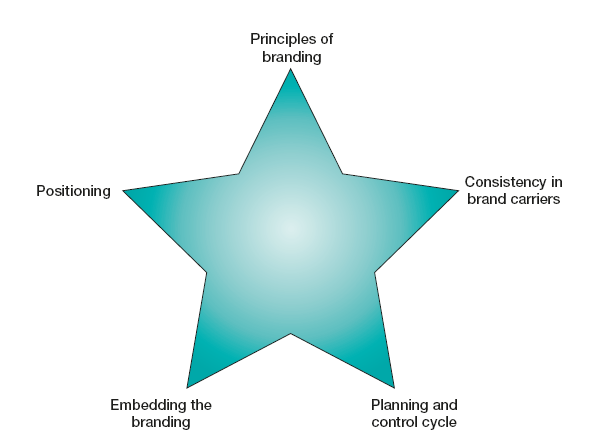
Its five connected points are:
- brand principles;
- positioning;
- consistency across brand carriers;
- organisational embedding;
- planning and control.
Working through every point turns brand policy into daily operating practice rather than leaving it as a communications statement.
Origins
The pentagram appeared in late-1990s product-and-brand-management literature and is associated with Michael Baker and Susan Hart’s Product Strategy and Management (nineteen ninety-nine). Its contribution was integrative: five concerns often managed separately—principles, position, carriers, organisational embedding and control—became one recurring system connected to corporate strategy.
What it is
The five parts connect intent with delivery. Brand principles establish mission, associations and architecture. Positioning defines the target and distinctive value. Brand carriers express the promise through products, communication and behaviour. Embedding assigns ownership and aligns culture and operations. Planning and control set targets, monitor experience and trigger adjustment.
How to use it
Develop the five points in sequence.
1. Principles of branding
Define:
- brand mission—the outcomes the brand should ultimately support;
- desired perception—the core values and associations it should own;
- brand architecture—the relationship among corporate, family and product brands.
2. Positioning
Select position through:
- segmentation—the criteria used to divide the market;
- target group—the clients or end users the brand prioritises;
- position—the distinctive value relative to competitors’ critical success factors, measured through both the proposed offer and the customer’s actual perception.
3. Consistency in brand carriers
List every carrier: products, services, spaces, messages, employee behaviour and intermediary behaviour. Define how each should express the same promise while allowing appropriate adaptation to channel and context. Audit communications and experiences for contradictions.
4. Embedding the branding
Align brand policy with functions, decisions and accountabilities. Assign executive or board-level authority and a named operational owner. Translate the promise into recruitment, training, processes, incentives and expected employee behaviour so it becomes part of the culture.
5. Planning and control cycle
Set short- and long-term SMART targets: specific, measurable, achievable, relevant and time-bound. Define methods, baselines and cadence, evaluate progress and use the evidence to adjust brand policy and operations.
Branding is strongest when the delivered experience matches the intended one and customers value the distinction. That alignment can support advantage; a persistent gap undermines trust and competitiveness.
Final analysis
Where brands are concerned, bear the following in mind:
- Brand meaning is inherently subjective and exists in stakeholder perception.
- Powerful brands may represent companies, services, organisations or aspirations rather than individual products.
- A brand takes many forms and cannot be reduced to a name or physical item.
The pentagram specifies the questions and management system, not the answers. It identifies what a brand strategy must address but does not determine the mission, position or expression for a particular organisation.
Top practical tip
Measure both sides of positioning: what the organisation promises and what customers perceive after experience. The gap between them is the most actionable output of the pentagram.
Top pitfall
Do not mistake framework completion for strategy. Generic values and consistent visuals cannot create a distinctive position when the product, behaviour and customer experience do not support it.
Further reading
Baker, M. and Hart, S. (1999) Product Strategy and Management. Harlow: Pearson Education.