 keymodels
Client pyramid (Curry)
How can client pyramid (curry) support strategic choice or positioning?
Contents
If you can successfully identify your most valuable customers, acquire them, keep them and increase their purchases, you will generate significantly more value than.
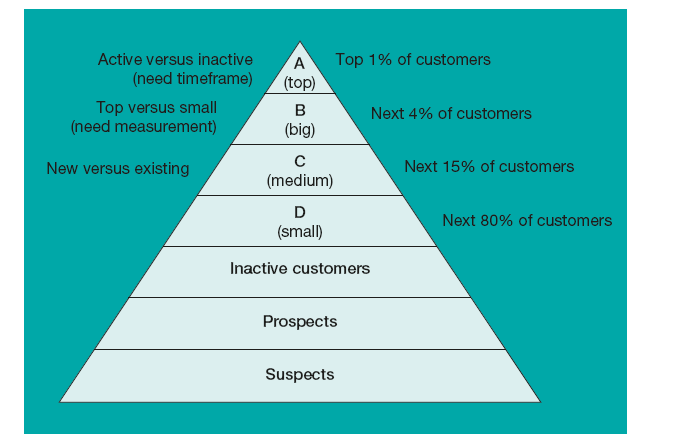
Customers differ in the revenue, profit, potential and strategic value they contribute. Jay and Adam Curry’s client pyramid segments the customer base into value tiers, placing a small group of high-value relationships at the top and larger groups of lower-value or prospective customers below. The purpose is to focus acquisition, retention and development effort where it can create the greatest return.
When to use it
Use the pyramid when a uniform sales or service model allocates similar effort to customers with very different economics. The analysis can:
- show how revenue and profit are distributed across the base;
- define differentiated account-management, marketing and service policies;
- protect and deepen the most valuable relationships;
- identify cross-selling and up-selling opportunities that can move suitable customers upward; and
- prevent high-cost attention from being assigned where the relationship cannot support it.
The model should guide fair differentiation in proposition and resource intensity, not poor treatment of customers placed in lower tiers.
Origins
Jay Curry introduced the customer-pyramid approach in Know Your Customers (nineteen ninety-two), drawing on direct marketing, database segmentation and the Pareto observation that a minority of customers often produces a disproportionate share of sales or profit. Jay and Adam Curry developed it further in The Customer Marketing Method (two thousand), connecting value tiers with differentiated acquisition, retention, cross-selling and service. The method is related to later customer-profitability segmentation, but tier rules must reflect the economics of the particular business.
What it is
The pyramid places current and potential customers into ordered tiers using economic and strategic value. A small top tier receives the most tailored relationship investment; larger lower tiers receive propositions and service appropriate to their needs, value and potential. Movement matters as much as placement: the organisation should acquire the right prospects, retain valuable customers and develop relationships whose future contribution can justify the investment.
How to use it
Define value before assigning tiers. Revenue and customer-level profitability are common inputs, but also consider cost to serve, payment behaviour, retention probability, growth potential, risk, referral value and strategic fit. Use a consistent period and avoid allowing one unusual transaction to determine placement.
The 80/20 rule is a useful hypothesis: roughly 20 per cent of customers may account for 80 per cent of profit. Actual concentration can be very different, and some high-revenue relationships may destroy value after service cost. Analyse the distribution rather than forcing the data to match the rule.
Then proceed through seven steps:
- Gather relevant, permissioned data about current and prospective customers, with particular depth for the highest-value relationships.
- Analyse contribution, needs, behaviour and potential; improve data definitions where the evidence is incomplete or inconsistent.
- Define how customers in each tier should experience the organisation and what proposition supports that position.
- Choose the channels, systems, cadence and content for interaction.
- Establish service packages, commercial rules and escalation paths for each tier.
- Embed customer-centred behaviour across functions so the segmentation is not confined to marketing.
- Monitor movement, retention, cost to serve and lifetime value, then refine the tiers and customer-management system as the organisation learns.
Review the pyramid regularly. Customers change, and an apparently small account may have substantial future or network value. Explain differentiated treatment internally and protect minimum standards for every tier.
Final analysis
The pyramid makes account-management and targeted-marketing choices concrete, but a historical customer database can create tunnel vision. Include attractive prospects and emerging segments instead of optimising only for the people who already buy.
Segmentation cannot compensate for a weak proposition. Acquisition and retention also depend on pricing, product or service value, coherent market strategy and a culture that supports the promised experience. The tiers are a resource-allocation aid, not a complete customer strategy.
Top practical tip
Define a distinct proposition, service level and development objective for every tier, then track whether customers move for the reasons the strategy intended.
Top pitfall
Revenue alone can place a demanding, low-margin client at the top of the pyramid. Include profitability, risk, growth potential and strategic fit—and avoid neglecting smaller clients that may become tomorrow’s best relationships.
Further reading
Curry, J. (1992) Know your Customers: How Customer Marketing can Increase Profits. London: Kogan Page.
Curry, J., and Curry, A. (2000) The Customer Marketing Method: How to Implement and Profit from Customer Relationship Management. New York: Free Press.