 keymodels
Compensation model
How can compensation model support strategic choice or positioning?
Contents
The compensation model is a conceptual framework for the design, implementation and assessment of a remuneration strategy in organisations.
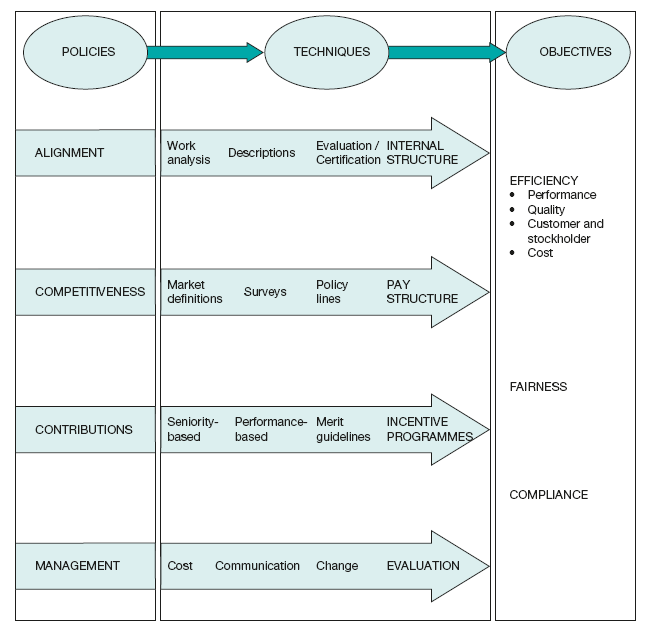
The compensation model is a framework for designing, operating and evaluating an organisation’s remuneration system. Associated with the work of George Milkovich and Jerry Newman, it connects three dimensions—objectives, policies and techniques—so individual pay practices can be assessed against the results the organisation wants.
When to use it
Use the model to diagnose an existing pay system, design a remuneration strategy or evaluate a proposed change to salary, incentives and benefits. It helps leaders connect market positioning and internal pay relationships with fairness, performance, legal obligations and operational governance.
Origins
George T. Milkovich and Jerry M. Newman developed the framework through successive editions of their influential textbook Compensation, first published in the 1980s and later updated with Barry Gerhart. The cited 2013 edition—and the 2013 teaching materials derived from it—present compensation as a strategic system rather than a collection of isolated pay practices, organising decisions around objectives, policy choices and implementation techniques.
What it is
- Objectives state what the pay system must achieve.
- Policies define the strategic choices that guide pay relationships and decisions.
- Techniques translate those choices into job structures, market data, incentives and administration.
How to use it
- Set objectives. Define the outcomes against which the system will be judged: efficiency, fairness and compliance. Efficiency means attracting and retaining the capability needed while controlling labour cost and supporting performance, quality and stakeholder value. Fairness concerns consistent treatment, understandable criteria and recognition of relevant contribution and need. Compliance requires adherence to pay, equality, tax, disclosure and employment law in every jurisdiction.
- Choose policies. Establish four sets of choices. Internal alignment defines the relative value of roles and the logic of pay differences inside the organisation. External competitiveness determines whether total rewards lead, match or lag relevant labour markets. Employee contribution determines how performance, competencies, seniority or other factors affect individual pay. Management assigns decision rights, communication, maintenance and exceptions. Even a technically sound system fails when nobody owns its consistent application.
- Select techniques. Use job analysis and evaluation to build internal structure; market surveys and benchmarking to assess external position; and ranges, incentive formulas, merit guidelines and benefits to express contribution policies. Model cost and distributional effects before implementation. Communicate how decisions are made, monitor outcomes by relevant employee groups and revisit the system as strategy, labour markets and regulation change.
At every stage, test whether the techniques still advance the objectives. There is no universally correct pay mix: the design must fit the work, workforce, culture and lifecycle of the organisation.
Final analysis
Culture and organisational maturity determine which rewards feel credible and how much sophistication the system can support. A complex incentive formula does not create strategic alignment if employees cannot influence or understand the measured outcome.
Compensation is only one part of the employment relationship. Meaningful work, development, leadership and working conditions also affect attraction and performance. Evaluate pay within that wider system and examine unintended behaviour as carefully as intended motivation.
Top practical tip
Write the efficiency, fairness and compliance objectives first. Evaluate every policy and technique against them, including cost, distribution and likely employee behaviour.
Top pitfall
People optimise what the reward system measures. Poorly chosen incentives can encourage gaming, short-termism, internal competition or unsafe behaviour, so test the likely side effects before implementation.
Further reading
Milkovich, G.T. and Newman, J.M. (2013) Compensation. 11th edn, New York: McGraw-Hill.