 keymodels
Cultural dimensions (Hofstede)
How can cultural dimensions (hofstede) improve people, teams, or organisational effectiveness?
Contents
Hofstede’s cultural dimensions can be used to develop an effective strategy to cooperate with people from various countries.
Hofstede’s cultural dimensions compare broad national patterns that may affect international work. Survey responses from IBM employees in more than 50 countries revealed recurring differences in how similar organisational questions were interpreted. The model can prepare a cross-cultural conversation, but country averages should never replace inquiry about an individual or organisation.
When to use it
Use the framework when international customers, partners, suppliers or colleagues may approach authority, groups, competition, ambiguity or time differently. It can surface hypotheses before a negotiation, team launch or market entry and help participants ask better questions before friction becomes failure.
Origins
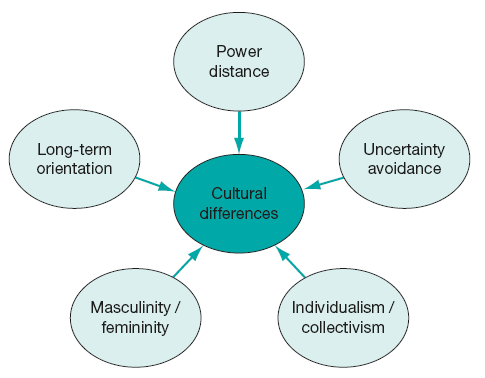
Dutch social psychologist Geert Hofstede developed the original dimensions from a large IBM employee survey conducted across countries from the late nineteen sixties into the following decade. His early model contained four dimensions. Later work added long-term orientation from research associated with Michael Bond, and subsequent editions expanded the framework further. The article retains the five-dimension version shown below.
What it is
1 Power distance
2 Individualism/collectivism
3 Masculinity/femininity
4 Uncertainty avoidance
A later comparison of western and eastern value patterns added a fifth dimension:
5 Long-term orientation.
The scores describe relative national tendencies, not rules of behaviour. Their value is to alert managers to possible differences and encourage observation and dialogue.
How to use it
Use each dimension as a question rather than an instruction:
- Power distance index (PDI) concerns acceptance and expectation of unequal authority. Compared at the same formal level, a Malaysian marketing manager in a high-PDI setting may receive less discretion than an Austrian counterpart in a lower-PDI organisation, where authority is less centralised.
- Individualism (IDV) versus collectivism compares loose ties and responsibility for self and immediate family with strong in-groups that offer protection in exchange for loyalty. US workplaces are often described as more individually oriented than many Asian workplaces, but team and company differences remain important.
- Masculinity (MAS) versus femininity contrasts emphasis on achievement, competition and material success with emphasis on relationships, care and quality of life. Japan is commonly positioned towards the former and Sweden towards the latter. The terminology is historically established but can reinforce gender stereotypes if interpreted literally.
- Uncertainty avoidance index (UAI) describes discomfort with ambiguity. Higher-UAI contexts tend to rely more on rules, safety measures and stable employment; lower-UAI contexts may tolerate experimentation and risk more readily.
- Long-term orientation (LTO) versus short-term orientation contrasts thrift and perseverance with stronger emphasis on tradition, social obligation and protection of face. China, Vietnam and Japan score relatively high in the model, while Australia, Germany and Norway score lower.
Do’s
- Expect that another person may interpret authority, commitment or disagreement differently from you, and ask rather than assume.
Don’ts
- Do not treat a national score as a prediction of an individual: no two people or organisations are identical.
Final analysis
The framework has made cultural variation easier to discuss in international organisations. Its limits are equally important: migration, generational change and cultural mixing alter patterns; national samples may not represent regions or minority groups; and variation within a country can exceed the average difference between countries. Use the model to prepare curiosity, not to claim certainty.
Top practical tip
Compare the scores before an important interaction, then convert every difference into a respectful question about this person, team and situation.
Top pitfall
Country averages do not describe an individual. Stereotyping from the dimensions hides regional, generational and situational variation and can worsen the very communication the model is meant to support.
Further reading
Hofstede, G. (1991). Cultures and Organisations: Software of the Mind. London: McGraw-Hill.
Hofstede, G. (2001) Culture’s Consequences: Comparing Values, Behaviours, Institutions, and Organisations across Nations Thousand Oaks, CA: Sage Publications.
Hofstede G. and Hofstede G.J, (2005) Cultures and Organizations: Software of the Mind, revised and expanded 2nd ed. New York: McGraw-Hill