 keymodels
Culture dimensions (Trompenaars)
How can culture dimensions (trompenaars) improve people, teams, or organisational effectiveness?
Contents
In their 1997 book, Fons Trompenaars and Charles Hampden-Turner introduced seven dimensions of culture that help in understanding and managing cultural differences.
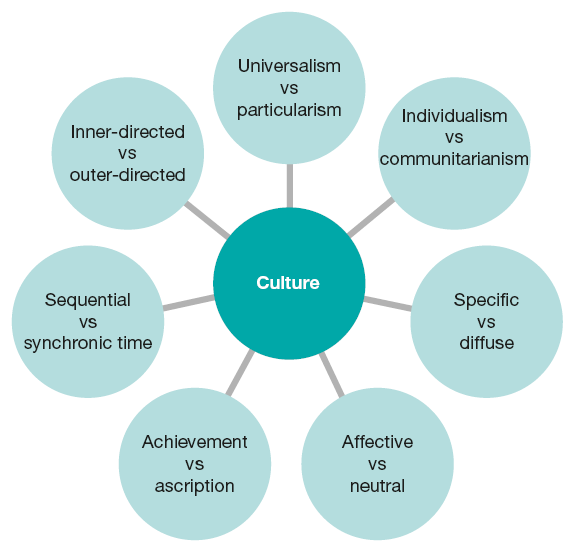
Fons Trompenaars and Charles Hampden-Turner’s 1997 book presents seven cultural dilemmas that influence how people interpret rules, groups, emotion, relationships, status, time and the environment. The framework is known as Trompenaars’ culture dimensions or the seven dimensions of national culture.
When to use it
Use the model when colleagues, customers or partners from different backgrounds face recurring tension in expectations. Awareness is only the beginning. Effective intercultural management requires dialogue and reconciliation: the parties seek a workable combination of different preferences rather than declaring one culture superior.
Origins
Trompenaars developed the model from international research into values and preferences, later working with Charles Hampden-Turner to explain cultural dilemmas and their reconciliation. Their 1997 book—and the 1997 discussions it prompted—brought the seven-dimension version to a broad management audience. The model proposes recurring national tendencies, not deterministic rules for individuals.
What it is
The dimensions organise seven common tensions:
- Universalism vs particularism (rules vs relationships).
- Communitarianism vs individualism (the group vs the individual).
- Neutral vs affective (the range of feelings and emotions expressed).
- Diffuse vs specific (the range of involvement).
- Achievement vs ascription (how status is accorded).
- Sequential vs synchronic time (how we manage time).
- Inner-directed vs outer-directed.
How to use it
Compare relevant national profiles to identify possible tensions, then discuss them with the people involved. Treat every score as a hypothesis about preference. Ask for concrete examples, agree how the work will be handled and look for reconciliation rather than requiring one side to assimilate.
- Universalism vs particularism. Universalism prioritises consistent rules and obligations, even where friends are involved. Particularism gives greater weight to relationships and circumstances. Reconcile them by agreeing core principles and a transparent process for legitimate exceptions.
- Individualism vs communitarianism. Individualism emphasises personal responsibility and achievement; communitarianism embeds achievement in group loyalty and welfare. Clarify individual accountability while showing how success benefits the group.
- Neutral vs affective. Neutral cultures value controlled expression, whereas affective cultures communicate emotion openly. Do not mistake restraint for indifference or enthusiasm for lack of discipline; agree how disagreement and commitment will be signalled.
- Specific vs diffuse. Specific cultures separate work roles from private life; diffuse cultures allow relationships and authority to span several domains. Make boundaries and relationship expectations explicit, especially outside office hours.
- Achievement vs ascription. Achievement accords status through performance; ascription attaches it more strongly to age, education, role, title or other attributes. Establish whose expertise and authority matter for each decision without demeaning either form of respect.
- Sequential vs synchronic. Time orientation may privilege past tradition, present relationship or future possibility. Sequential cultures favour one task at a time and firm schedules; synchronic cultures handle several activities in parallel and treat timing more flexibly. Agree which deadlines are fixed, what can move and how conflicts will be escalated.
- Inner-directed vs outer-directed. Inner direction assumes people can shape the environment; outer direction emphasises adaptation and harmony with external forces. Combine clear agency with attention to context and feedback.
Final analysis
The dimensions give international teams a shared vocabulary for misunderstandings and can reduce coordination cost. Trompenaars and Hampden-Turner also recognise that cultures evolve and mingle; their consulting work maintains a cross-cultural dataset covering over 100 countries and periodically updates national profiles.
Like Hofstede’s dimensions (see Cultural dimensions (Hofstede)), the model can understate variation within nations. Trompenaars and Hampden-Turner acknowledged multicultural South Africa in their 1997 book, yet any national average can still hide regional, organisational and individual preference.
Top practical tip
Use the national profile to prepare seven questions, then let the colleague or partner describe their actual preferences and agree how to reconcile the important differences.
Top pitfall
Do not convert a country score into a stereotype. National, regional, organisational and individual cultures can differ substantially, as multicultural South Africa makes especially clear.
Further reading
Trompenaars, A. and Hampden-Turner, C. (1993) Riding The Waves of Culture: Understanding Diversity in Global Business. New York: Random House.
Trompenaars Hampden-Turner Consulting: www.THTconsulting.com