 keymodels
Eight phases of change (Kotter)
How can eight phases of change (kotter) improve people, teams, or organisational effectiveness?
Contents
Kotters’s eight phases of change is a systematic approach to achieving successful, sustainable change by breaking down the change process into eight phases.
John Kotter’s eight-phase model provides a sequence for mobilising and embedding large-scale organisational change. Drawing on transformation research involving more than 100 companies and work published in 1990 and 1995, it responds to recurring failures: complacency, weak sponsorship, unclear vision, poor communication, blocked action, insufficient early wins, premature victory and failure to anchor new behaviour.
When to use it
Use the framework when change requires coordinated leadership across a substantial organisation. Kotter distinguishes management—keeping complex operations reliable—from leadership—defining a future, aligning people and generating commitment. The model helps leaders organise that mobilisation without mistaking a new structure or system for completed change.
Origins
John P. Kotter developed the process by studying more than one hundred organisational transformations. He presented the failure patterns and corrective stages in the mid-nineteen-nineties and expanded them in Leading Change. Later work with Dan Cohen placed greater emphasis on emotion and visible behaviour. Terminology has since evolved, but the underlying sequence remains recognisable.
What it is
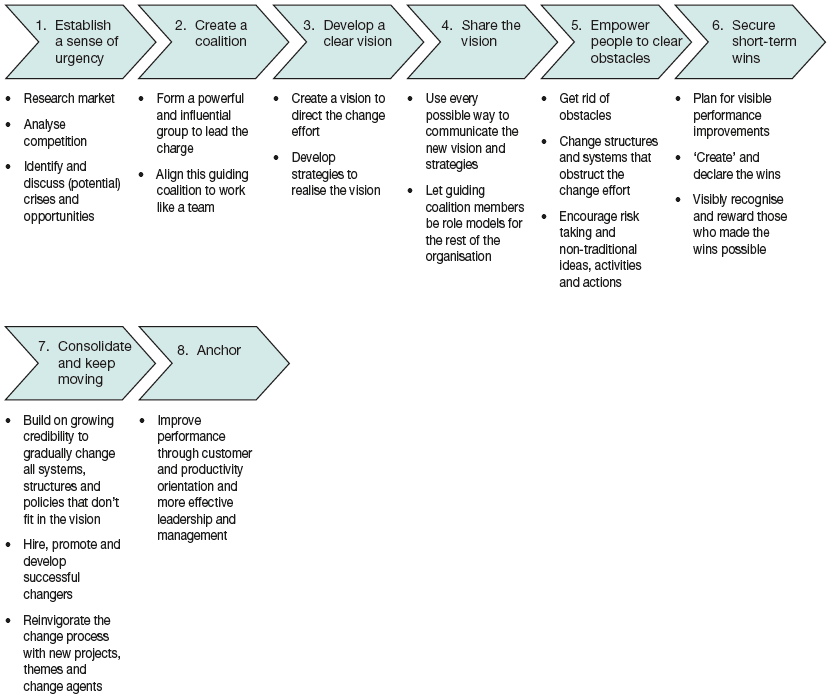
The model connects eight leadership tasks: create urgency, form a guiding coalition, define a strategic vision, communicate and enlist people, remove barriers, produce short-term wins, sustain acceleration and anchor the change in culture. The phases are cumulative but not mechanically linear; several initiatives may occupy different phases at once.
How to use it
- Create urgency. Replace complacency with credible evidence that the status quo carries material risk or that a time-limited opportunity exists. Avoid manufacturing panic.
- Build the guiding coalition. Assemble people with authority, expertise, credibility, relationships and commitment. Develop enough trust to resolve difficult trade-offs.
- Form a clear vision. Describe the future state and the strategic initiatives that make it plausible. The vision should guide decisions without pretending every detail is known.
- Communicate and enlist. Repeat the vision through words, decisions and leader behaviour. Invite participation, test understanding and address contradictions.
- Remove barriers. Change structures, incentives, skills, systems and assumptions that prevent people from acting. Empowerment requires practical capacity, not only permission.
- Generate short-term wins. Plan visible, unambiguous outcomes related to the change. Recognise contributors and use the evidence to build credibility.
- Sustain acceleration. Use early wins to tackle deeper systems and bring more people into the effort. Do not declare victory while old routines can still reassert themselves.
- Institute the change. Connect new behaviour with improved results, embed it in recruitment, development, promotion and governance, and ensure future leaders reinforce it.
Final analysis
The model is a disciplined checklist, not a guarantee. Change remains political, emotional and unpredictable, and local context may require iteration. Its strongest contribution is to show that execution involves far more than announcing a decision: people need motive, coordination, capability, evidence and reinforcement.
Top practical tip
Build urgency from shared evidence and a credible opportunity, then maintain it with visible progress. Fear without agency exhausts people; urgency should clarify why action matters and what people can do now.
Top pitfall
Do not treat the phases as a communications campaign or declare completion after early wins. Structural barriers, incentives and cultural reinforcement determine whether new behaviour survives once leadership attention moves elsewhere.
Further reading
Kotter, J.P. (1990) A Force for Change: How Leadership Differs from Management. New York: Free Press.
Kotter, J.P. (1996) Leading Change. Cambridge MA: Harvard Business School Press.
Kotter, J.P. (2002) The Heart of Change: Real-life stories of How People Change their Organisations. Cambridge MA: Harvard Business School Press.