 keymodels
Investment stages
How can investment stages improve people, teams, or organisational effectiveness?
Contents
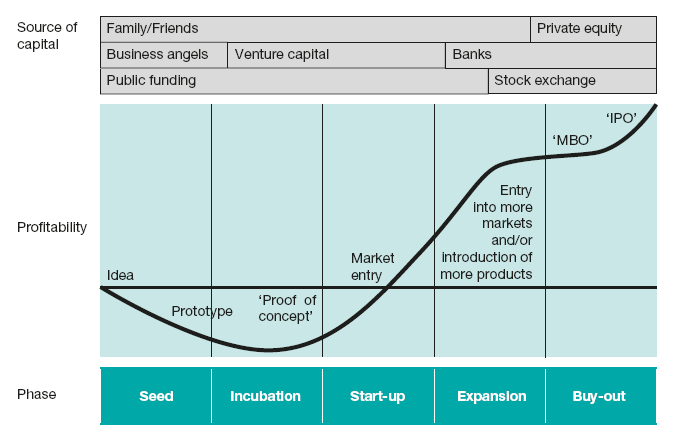
Investment stages is a model that can be used to determine the availability of different sources for financing business activities at different phases (stages) in the.
The investment-stages model connects a company’s maturity, risk and cash requirements with financing sources that are commonly available at each point. It can guide founders seeking capital and investors deciding where their mandate and risk appetite fit.
When to use it
Use the model when financing a new venture, scaling an established business or screening an investment opportunity. Early ventures often lack collateral, predictable cash flow and operating evidence, while later stages may qualify for a broader mix of equity, debt and strategic funding.
Origins
Stage-based financing emerged from venture-capital practice as investors matched capital, governance and risk to the changing needs of young companies. The professional industry developed after the Second World War, and its vocabulary later distinguished seed, start-up, early, expansion and exit stages. No taxonomy is universal; definitions vary by investor, jurisdiction and data provider, and terms such as pre-seed have shifted older boundaries.
What it is
At the earliest stage, founders, friends and family, grants, accelerators, angels and seed funds may finance problem validation and initial development. Venture capital and strategic investors become more relevant as product, team and market evidence accumulates. Growth equity, asset-backed lending and other debt may become accessible as revenue, assets and cash flows mature. Public markets are one possible later route, not the required destination.
The model is a map of common availability, not a rule. Bootstrapping, customer finance, revenue-based finance, community funding and blended structures may suit a venture better than the conventional sequence.
How to use it
First define the venture’s actual stage through evidence: problem validation, product readiness, regulatory path, customer traction, economics, team capability and cash runway. Estimate the capital needed to reach the next value-creating milestone, including contingency.
For each plausible source, compare cost of capital, dilution, repayment, collateral, governance rights, covenants, timing, investor expertise and alignment. Prepare a clear use-of-funds case and explain how the investment creates a return. Protect intellectual property appropriately without granting rights that compromise future financing or control.
Conduct due diligence on investors as carefully as they assess the company. Model downside, follow-on needs and the consequences of missing milestones. After closing, monitor covenants and reporting commitments, and begin the next financing conversation before runway becomes critical.
Investors can reverse the process: identify the company’s stage, test whether the requested amount and valuation match its evidence, assess securities and governance, and plan the likely holding period and exit routes. This is financial decision support, not a substitute for professional legal, tax or regulated investment advice.
Final analysis
The model is useful because it makes changing risk and capital needs visible to both sides. Its abstraction is also its limit: it cannot determine whether a specific source, term sheet or business is attractive.
Do not treat an initial public offering as the pinnacle of financing. Large private and family-owned businesses often use several sources, and the appropriate structure depends on strategy, ownership preferences and cash economics.
Top practical tip
Raise enough capital to reach a specific evidence milestone, and compare investor fit and terms—not just headline valuation.
Top pitfall
A stage label does not assess a company or financing instrument. Validate cash needs, dilution, covenants, downside and jurisdiction-specific obligations independently.
Further reading
Marks, K.H., Robbins, L.E., Fernandez, G., Funkhouser, J.P. and Williams, D.L. (2009) The Handbook of Financing Growth: Strategies, Capital Structure, and M&A Transactions, 2nd edn. Wiley.
Preston, S.L. (2007) Angel Financing for Entrepreneurs: Early-Stage Funding for Long-Term Success. San Francisco, CA: Jossey-Bass.