 keymodels
Organisational configurations (Mintzberg)
How should organisational configurations (mintzberg) be measured and interpreted?
Contents
The organisational configurations framework of Mintzberg (1983) describes six organisational configurations.
Mintzberg’s organisational-configurations framework (1983) explains how an organisation’s dominant part, preferred coordination mechanism and distribution of power tend to reinforce one another. It describes six recurring configurations that make complex structures easier to diagnose. The framework is most useful as a way to test whether strategy, work and structure fit together—not as a set of organisational templates to copy.
When to use it
Use the configurations when a strategy is being translated into an operating model, when coordination repeatedly fails, or when a reorganisation is under consideration. The analysis can reveal which part of the organisation currently has the most influence, how work is actually coordinated and whether those choices are mutually consistent. It can also show what must change if the organisation’s strategic priorities or environment have changed.
Origins
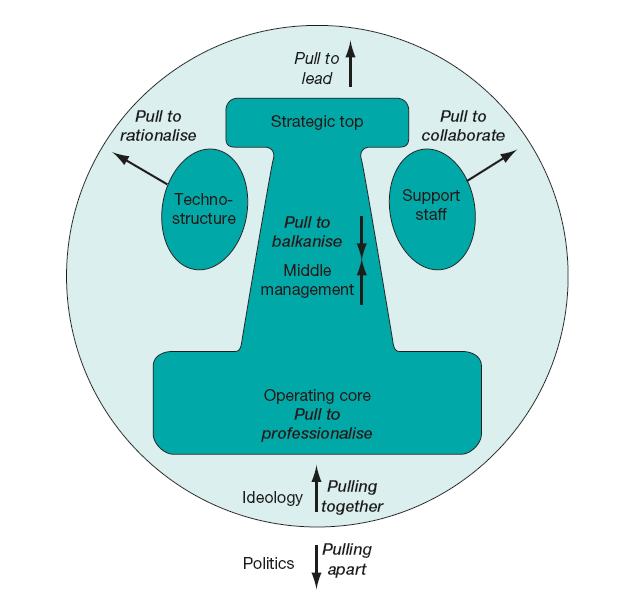
Henry Mintzberg developed the configurations approach from his research on how organisations divide work and coordinate it. His early typology centred on five structural forms; later presentations incorporated ideology as an additional organisational part and missionary organisation as a sixth configuration. The result is a contingency view: effective organisation depends on alignment among structure, coordination and context, rather than on one universally superior design.
What it is
The model connects four questions: which organisational part is dominant, which mechanism coordinates work, how power is distributed and which contextual conditions shape the design. Recurring answers form recognisable configurations such as entrepreneurial, machine, professional, diversified, innovative and missionary organisations. Real organisations commonly combine them or move between them.
How to use it
Begin by mapping the six elementary parts of the organisation:
- the operating core
- the strategic top management
- the middle management
- the techno-structure
- the support staff
- the ideology part.
The first three normally form the formal line of authority. The operating core performs the essential work, the strategic apex sets overall direction and the middle line connects the two. The techno-structure designs standards and systems; support staff provide services outside the core workflow. Ideology comprises the values, traditions and shared beliefs that surround and permeate the organisation. External actors—including shareholders, suppliers, customers and regulators—also influence how these parts behave.
Next, identify how work is coordinated. Direct supervision, standardisation of work, outputs or skills, mutual adjustment and shared norms each solve different coordination problems. When no mechanism has sufficient legitimacy or capacity, units may compete for influence and the organisation can become politicised.
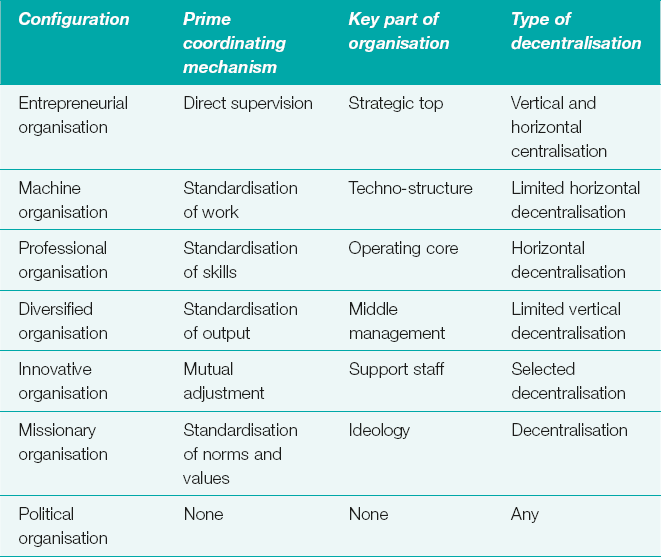
Then examine the design parameters that sustain the current configuration: job specialisation, behavioural formalisation, training, indoctrination, unit grouping and size, planning and control systems, and liaison devices such as integrator roles, task forces and matrix relationships. Pay particular attention to decentralisation, because the location of decision rights often determines which organisational part dominates.
Finally, test the configuration against context. Age, size, technical systems, environmental complexity and stakeholder demands may favour different arrangements. Compare the intended design with observed decisions and workflows, identify contradictions, and change the smallest set of mutually reinforcing elements rather than redrawing the organisation chart alone.
Final analysis
The configurations are ideal types, not blueprints or diagnostic labels. Most organisations are hybrids, and different divisions may require different coordination mechanisms. Classification is therefore less important than understanding the relationships among the nature of the work, the dominant organisational part, decision rights and coordination.
A structure that suits a large, stable manufacturer may be completely inappropriate for a small repair shop or a fast-moving research unit. Use the framework to generate and test design hypotheses, then validate them with workflow evidence, employee experience, performance data and the organisation’s actual constraints.
Top practical tip
Start by mapping the organisation’s basic parts, then identify which part dominates and how work is actually coordinated. Misalignment between those observations is usually more informative than the configuration label itself.
Top pitfall
Do not treat an ideal configuration as a blueprint. Hybrid structures are normal, and forcing an organisation into one category can conceal important differences among units, professions and workflows.
Further reading
Mintzberg, H. (1989) Mintzberg on Management. New York: Free Press.
Mintzberg, H. (1992) Structure in Fives. New York: Prentice Hall.