 keymodels
Strategic dialogue
How should strategic dialogue be measured and interpreted?
Contents
An eight-step, stakeholder-engaged cycle that integrates strategy formulation, mobilisation, execution and monitoring.
Strategic dialogue is a generic eight-step process for creating and implementing strategy. It treats formulation and execution as one iterative system, combining the quality of the strategic content with the quality of the process used to create commitment. The dialogue explores options with relevant external and internal stakeholders while preserving explicit decision rights. Participation informs strategy; it does not turn accountability into a vote.
When to use it
Use strategic dialogue when an organisation must make and implement choices across functions, or when success depends on knowledge and commitment held by partners and stakeholders. It is particularly useful where analysis alone will not create shared understanding, yet leaders still need a disciplined path from exploration to decision and delivery.
Origins
Strategic dialogue is a practical synthesis rather than a framework derived from one founding publication. It reflects the movement away from strategy as an isolated annual plan, recognition that formulation and implementation shape each other, the use of scenarios to explore uncertainty and wider stakeholder participation in sense-making. The version here responds to recurrent failures: inward-looking analysis, assumed consensus, ambiguous choices and implementation plans without organisational ownership.
What it is
Three conditions shape an effective strategy process:
- Context: participants need a shared understanding of the starting position, the reason for change and the ambition. Without knowing where the organisation stands, they cannot set a coherent direction.
- Content: the analysis must have sufficient quality, breadth and depth. Appropriate models and evidence should clarify the organisation’s capabilities, constraints and environment and provide a basis for genuine options.
- Process: engagement must be designed deliberately. Decide who participates, when, in what role and through which methods. A strong process improves understanding, creativity and the quality of ideas.
The approach expresses strategic success as:
Formulation × Mobilisation × Realisation
Multiplication matters: excellent work in one dimension cannot fully compensate for failure in another.
Formulation
Organisations often concentrate on formulation, expecting a well-written plan to guide them through uncertain markets. Yet no plan can anticipate every development. Choices may not combine rigorous analysis with entrepreneurial judgement, and many strategies state what the company will start without identifying what it will stop. Even a sound choice does not guarantee consistent interpretation or execution.
Realisation
Implementation usually receives the next greatest share of attention. Some organisations produce encyclopaedic plans; others create fragments. Most establish milestones, change projects, communication and management reviews. Operational crises can still displace strategic work from the agenda. A brilliant strategy and detailed programme may therefore fail to deliver when ownership, priorities and behaviour do not change.
Mobilisation
The missing variable is often mobilisation: involving the people and partners whose knowledge, action and support determine both the strategy and its implementation. Modern organisations face long-term strategic choices while investors, lenders and other parties demand short-term results. Risk tolerance can be low and adjustment must be rapid. Mobilisation creates understanding and commitment without obscuring who must ultimately decide.
When to use it
Strategic dialogue was designed to counter common problems in the scope, execution and decision stages of strategy:
| *Aspect* | *Pitfall* | *Description* |
|---|---|---|
| Scope | ‘Me too’ | Copying a visible or irritating competitor instead of reasoning from the organisation’s situation. |
| Scope | ‘The grass is always greener’ | Chasing attractive-looking initiatives without a disciplined comparison. |
| Scope | ‘Collective truth’ | Treating internal consensus as evidence and neglecting analysis outside the organisation’s shared assumptions. |
| Scope | ‘We’ve always done it this way’ | Allowing past experience to prevent a serious examination of change. |
| Scope | ‘We know what they want’ | Assuming customer or market needs instead of investigating them. |
| Execution | ‘An elite activity’ | Restricting strategy to senior management and excluding knowledge held elsewhere. |
| Execution | ‘No time to discuss’ | Compressing the process until people cannot test assumptions or understand choices. |
| Execution | ‘The controller as strategist’ | Presenting a budget revision—last year’s plan +5%—as strategy. |
| Execution | ‘Paralysis by analysis’ | Extending analysis indefinitely to avoid uncertainty and choice. |
| Execution | ‘Talk about them, not with them’ | Discussing important stakeholders while avoiding direct engagement. |
| Choices | ‘It’s all about the money’ | Allowing financial measures to displace every other strategic consideration. |
| Choices | ‘The hockey stick effect’ | Letting ambition produce an unsupported optimistic long-term curve. |
| Choices | ‘Let’s make a compromise’ | Preserving universal comfort by refusing to make a meaningful trade-off. |
| Choices | ‘There is only one boss...’ | Centralising every decision and then wondering why others neither understand nor act. |
| Choices | ‘Another good plan (for the file)’ | Completing the document without changing activity. |
Adapt the process to its context. A restructuring, acquisition, merger or external disruption creates different demands. Limited time may compress exploration; confidentiality may restrict participation. These constraints should shape the dialogue openly rather than being mistaken for a universal process design.
How to use it
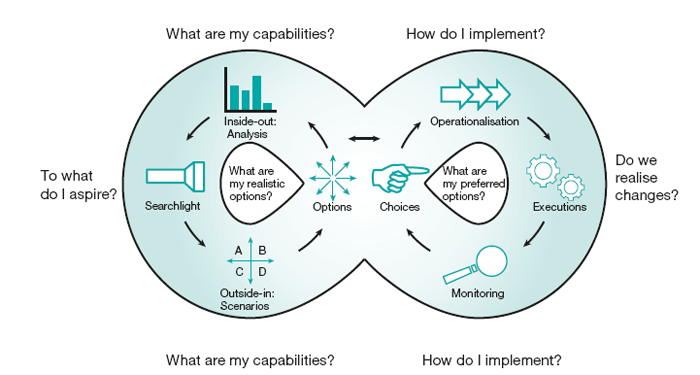
Move through eight connected steps, tailoring depth and participation:
- Searchlight: establish the strategy process, shared ambition and business scope.
- Outside-in—scenarios: examine plausible future environments and the positions they could make attractive or necessary.
- Inside-out—analysis: assess strategic possibilities using the organisation’s resources, capabilities and constraints.
- Options: convert evidence into insight and generate coherent alternatives.
- Choice: compare risk, feasibility and value and make an explicit strategic decision.
- Operationalisation: translate the choice into an implementation design, responsibilities and useful early wins.
- Execution: carry out the policies, investments and organisational changes.
- Monitoring: track the environment, organisational performance and strategic assumptions and feed learning back into the cycle.
Other management models can support analysis, design or interaction within any step. Select them for the decision at hand rather than forcing a standard toolkit onto every situation.
The process is often pictured as two linked circles—formulation and implementation—forming a lemniscate. The left cycle develops mission, vision and strategy through fluid, creative interaction. The centre makes the choice. The right cycle converts that choice into more structured action. The infinity form emphasises that monitoring and experience return to formulation rather than ending the process.
The final analysis
Strategic success depends on analytical content, implementation quality and the way participation and communication are organised. Effective dialogue increases the likelihood that people understand the choice and can act on it. It does not remove disagreement or leadership accountability.
Before beginning, determine:
- who should participate and what role each person holds;
- how understanding and commitment will be built among people who do not participate directly;
- whether the team can contribute high-quality analysis and think systematically about the future;
- which models, evidence and facilitation methods fit the question;
- how non-participants will be informed while the work is underway and when choices become visible;
- how the organisation will maintain agreed procedures and accountability during implementation.
How to use it
Treat the steps as a cycle rather than a hand-off. Record assumptions, evidence, dissent, choices and rejected alternatives. Give each action an owner and connect monitoring indicators with the assumptions they test. Reopen a strategic choice when evidence invalidates it, not merely when implementation becomes uncomfortable.
Design participation around contribution: customers and partners may inform context, specialists may deepen analysis, and operational teams may expose delivery constraints. State who advises, who recommends and who decides so that dialogue strengthens rather than blurs governance.
Top practical tip
Build mobilisation into formulation. Involve the people whose knowledge and commitment are necessary, and state decision rights before the dialogue begins.
Top pitfall
Do not allow dialogue to become sophisticated avoidance. Make dissent safe, then finish with explicit choices, stopped activities, owners and review points.
Further reading
- van der Heijden, K. (nineteen ninety-six). Scenarios: The Art of Strategic Conversation. Wiley.
- Senge, P.M. (nineteen ninety). The Fifth Discipline: The Art and Practice of the Learning Organization. Doubleday.