 keymodels
Team roles (Belbin)
How can team roles (belbin) improve people, teams, or organisational effectiveness?
Contents
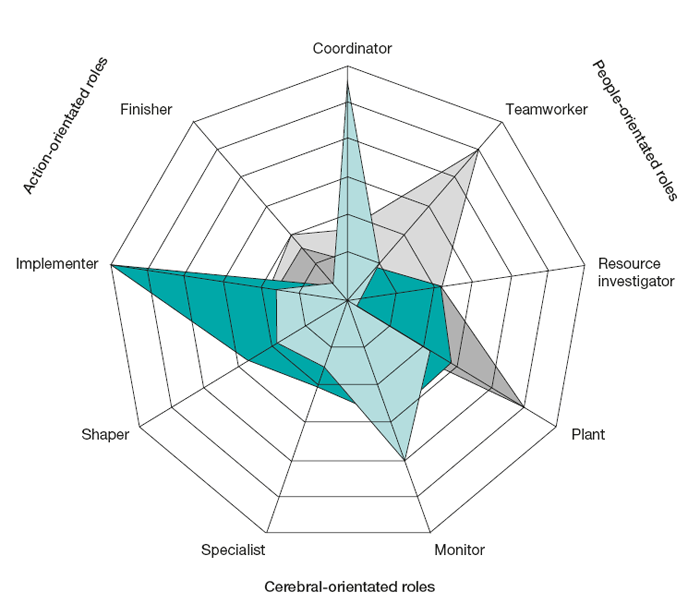
Belbin (1985) distinguishes nine complementary roles of successful business teams that can be classified as follows:
Belbin’s team-role model describes nine recurring contributions that help a group perform. The roles concern behaviour within a team, not job titles or fixed personality types; one person may contribute through several roles as circumstances change.
When to use it
Use the model when assembling a team for work that demands a deliberate combination of skills and behaviours, or when an established team needs to improve cooperation. Ask prospective members which contributions they can and want to make, then compare those preferences with evidence from colleagues and observed work.
The discussion is valuable in its own right. It gives people a shared language for strengths, limitations and collaboration, making it easier to use complementary abilities, cover gaps and agree how the team will adapt.
Origins
R. Meredith Belbin developed the framework through a long-running research programme at Henley Management College. His team observed managers completing business simulations and studied how different combinations of behaviour affected performance. The findings were published in Management Teams: Why They Succeed or Fail. The model began with eight roles; Specialist was added later to create the nine-role version in current use.
What it is
| *People-orientated roles* | *Cerebral roles* | *Action-orientated roles* |
|---|---|---|
| 1. Coordinator | 4. ‘Plant’/creator/inventor | 7. Shaper |
| 2. Team worker | 5. Monitor/evaluator | 8. Implementer |
| 3. Resource investigator | 6. Specialist | 9. Finisher |
- The coordinator clarifies objectives, supports decisions and delegates work. Confidence and maturity can create focus, although overuse may feel controlling or manipulative.
- The team worker listens, connects people and reduces friction. Diplomacy helps the group cohere, but difficult moments may expose indecision.
- The resource investigator brings energy, contacts and external opportunities. Curiosity opens doors, while a short attention span can leave follow-through to others.
- The plant generates original ideas and unconventional solutions. Deep concentration can produce breakthroughs but may also lead to weak communication or disregard for practical details.
- The monitor/evaluator weighs alternatives and judges progress soberly. Sound analysis improves decisions, although the role may contribute less drive or inspiration.
- The specialist supplies rare, focused expertise. That depth can be indispensable, but the contribution may remain narrow or become overly technical.
- The shaper creates urgency and pushes through obstacles. This is useful under pressure, provided directness does not become provocation.
- The implementer converts ideas into dependable action. Discipline keeps delivery moving, though rigidity can make a change of course harder.
- The finisher checks detail, protects standards and closes work on time. Conscientiousness prevents errors, but anxiety and reluctance to delegate can slow the team.
How to use it
Build each member’s role profile through a combination of:
- self-assessment, using scores, rankings or distributed weights and, where useful, a facilitator;
- team assessment during a small assignment or simulation, followed by peer feedback; and
- an independent view from a mentor, former teammate, colleague or supervisor.
Compare the profiles with the work ahead. Look for missing contributions as well as excessive concentration in one role, then adjust membership, responsibilities or working agreements. Treat the profile as a prompt for observation and conversation, not as permission to stereotype a person.
Final analysis
The framework assumes that team behaviour can be assessed with reasonable objectivity, which remains debatable. Even so, it often helps people recognise themselves and make team dynamics discussable.
Complementarity matters. Too many coordinators may compete for control, while several monitors can prolong evaluation without creating action. Yet a balanced chart cannot guarantee a functioning team: trust, conflict, context and interpersonal chemistry also shape performance. People may also rise to an unfamiliar role when the situation creates a genuine need.
Top practical tip
Ask members which roles they prefer, then test those preferences against observed behaviour and the work the team must deliver.
Top pitfall
A balanced role profile does not compensate for poor trust, damaging relationships or an unhealthy team environment.
Further reading
Belbin, R.M. (1985) Management Teams: Why They Succeed or Fail. London: Heinemann.