 keymodels
Blue ocean strategy
How should blue ocean strategy be measured and interpreted?
Contents
Most firms compete in established ‘red ocean’ markets, with well-entrenched competitors and a clearly-defined set of customer expectations.
Most companies operate in established “red oceans,” where competitors are entrenched and customer expectations are familiar. A company sometimes creates a “blue ocean” by shaping demand for an offer the market did not previously recognise. When that new space is commercially meaningful and defensible, it can produce growth and profitability beyond what head-to-head competition allows.
When to use it
- To determine whether the current strategy is meaningfully different from competitors’ strategies.
- To redesign an existing offer around a more distinctive value curve.
- To discover opportunities for offers and demand that do not yet exist.
Origins
Strategy research has long observed that exceptional companies often rewrite an industry’s conventions. IKEA rose during the 1970s through a different system for designing, producing and selling furniture. The commercial internet made rule-breaking easier in the mid-1990s and helped popularise the language of business models. Amazon competed with Barnes & Noble and Waterstones through a fundamentally different formula for retailing books and creating value.
Researchers in the 1990s and 2000s examined how firms could create new business models or defend themselves against them. Important contributions included Gary Hamel’s Leading the Revolution and Costas Markides’s All the Right Moves. INSEAD professors W. Chan Kim and Renée Mauborgne first articulated “value innovation” in a nineteen ninety-seven Harvard Business Review article, then developed the most influential and comprehensive toolkit in Blue Ocean Strategy (two thousand and five).
What it is
Kim and Mauborgne use red and blue oceans to distinguish two competitive settings. Red oceans are today’s known industries, with accepted boundaries and rules. Companies fight for share, and crowding progressively constrains growth and margin; automobiles, consumer products and airlines provide familiar examples. Blue oceans are new market spaces where demand is created rather than captured from an incumbent and the competitive rules have not yet solidified. Apple’s iTunes helped establish a legal market for downloaded music, while the iPad made tablet computing a mass-market category. These spaces do not remain uncontested forever, but early value innovation can make current rivals temporarily less relevant.
How to use it
The method provides tools for identifying and developing such opportunities. Begin with the outcomes customers and noncustomers value, then search for a different way to provide them. A strategy canvas places the factors on which the industry competes along the horizontal axis and the level of each factor offered along the vertical axis. Plotting the firm alongside close and distant alternatives makes strategic similarity visible. In the example, firms A and B follow nearly the same profile, while firm C diverges.
The canvas describes the known market by showing what competitors invest in and the value buyers receive. It also prompts redesign: where is the industry over-serving customers, where is it failing them and what source of value is entirely absent? The four-actions framework structures that discussion:
- Which taken-for-granted factors should be eliminated?
- Which factors should be reduced far below the industry standard?
- Which factors should be raised far above it?
- Which factors that the industry has never provided should be created?
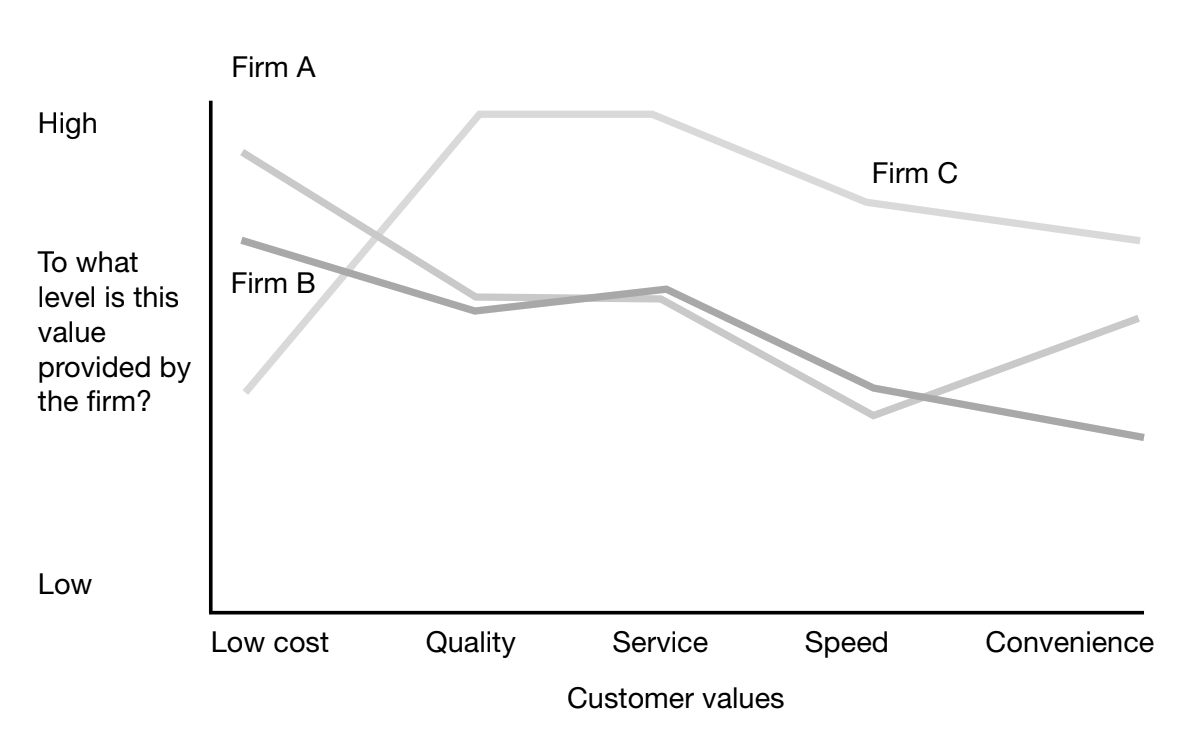
The intended result is “value innovation”: a simultaneous increase in buyer value and reduction in the company’s cost base. This challenges a simplified reading of Michael Porter in which a firm must choose differentiation or low cost. Eliminating and reducing low-value factors can release resources for raising and creating the factors that matter. As imitators enter, however, the blue ocean becomes red, conventions solidify and the tension between cost and differentiation may re-emerge.
Top practical tip
The tools organise analysis, but the decisive step is a creative insight about an offer that does not yet exist. Break the hold of industry experience by studying alternatives, observing noncustomers and assembling a heterogeneous team that includes newcomers able to question established rules.
Top pitfall
Do not confuse novelty with a valuable market. Many apparent blue oceans are mirages or small niches. Test noncustomer demand, willingness to pay, delivery cost and imitation risk before treating an imaginative value curve as a growth opportunity.
Further reading
- Kim, W.C. and Mauborgne, R. (nineteen ninety-seven). “Value Innovation: The Strategic Logic of High Growth.” Harvard Business Review.
- Kim, W.C. and Mauborgne, R. (two thousand and five). Blue Ocean Strategy. Harvard Business School Press.