 keymodels
CAGE distance framework
How can cage distance framework support strategic choice or positioning?
Contents
The CAGE distance framework, introduced by Pankaj Ghemawat, identifies differences between countries that organisations must address when doing business internationally.
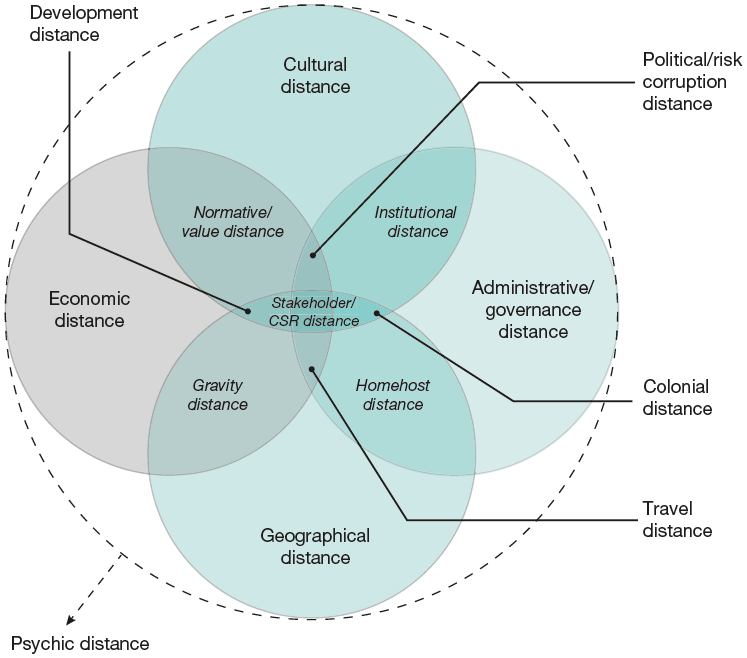
Pankaj Ghemawat’s CAGE framework helps organisations examine the distance between countries before committing to international expansion. It separates distance into four dimensions—cultural, administrative, geographic and economic—because the visible size of a foreign market says little about how difficult it will be to serve from a particular home base.
When to use it
Use CAGE to compare candidate markets, adapt an entry strategy or understand why an international operation is underperforming. The analysis is useful for:
- adjusting market potential for the friction created by cross-country differences;
- identifying the organisation’s liability of foreignness in a target country;
- determining which products, activities or industries are especially sensitive to particular forms of distance;
- anticipating adaptations, partnerships and capabilities required for entry; and
- assessing foreign competitors both in their home markets and in yours.
CAGE can also reveal barriers that protect the home market. The comparison is always relative: the same target country may be close to one competitor and distant from another.
Origins
Pankaj Ghemawat introduced the framework in his two thousand and one Harvard Business Review article “Distance Still Matters: The Hard Reality of Global Expansion.” It challenged the assumption that globalisation had made national differences commercially unimportant. Ghemawat later developed the approach in Redefining Global Strategy (two thousand and seven), using the CAGE acronym to organise the cultural, administrative, geographic and economic differences that shape cross-border activity.
What it is
CAGE is a bilateral and industry-sensitive comparison, not a universal league table of countries. It asks how far a target market is from a specific home base on four dimensions and how much each difference matters to the product, customer and activity being considered. Distance usually creates friction, but it can sometimes create opportunity—for example, economic differences may enable complementary locations for production and demand.
How to use it
Compare the home and target country on four dimensions:
- Cultural distance. Examine language, religion, ethnicity, values, social norms and attitudes towards authority, markets and globalisation. Cultural distance is especially important where products communicate identity, tastes vary or trust depends on interpretation.
- Administrative distance. Compare legal systems, regulation, political risk, institutions, corruption, currencies and trade arrangements. Historical links, colonial relationships or membership of the same political and trading blocs can reduce this distance.
- Geographic distance. Go beyond kilometres. Consider shared borders, time zones, transport and communications infrastructure, internal remoteness, topography and natural barriers. Weight this dimension heavily for bulky, perishable or time-critical goods.
- Economic distance. Compare household income, labour and input costs, human and natural resources, infrastructure and the sophistication of markets. Large differences can constrain demand or require a different proposition and operating model.
Start by specifying the industry, product and value-chain activity. A country pair cannot be assigned one useful distance score without this context: geography matters greatly to cement or fresh food, while cultural preferences may matter more to media and consumer brands.
Collect evidence for relevant sub-dimensions, using consistent data for each candidate market. Rate both the magnitude of the difference and its likely commercial effect. Then adjust the initial view of market attractiveness for expected adaptation costs, operating risk and the loss or transferability of competitive advantage.
Translate each material distance into a response: adapt the offer, partner locally, alter the entry mode, relocate an activity, build a bridging capability or reject the market. Available CAGE databases and the online comparator can inform the comparison, but managerial judgement is still needed to connect distance with the particular business.
Final analysis
CAGE combines established international-business insights with a memorable structure and makes implicit concerns about foreign markets discussable. Its strength is disciplined comparison, especially when used to challenge a market ranking based only on population, growth or income.
It remains indicative rather than decisive. Data can describe differences but cannot choose a target market, determine whether an organisation can bridge them or quantify every interaction among the four dimensions. The same distance can matter differently by industry, company and entry mode.
Because the analysis is relative to a home base, do not copy another firm’s country ranking. A competitor’s language, political relationships, supply chain or cost structure may make a market much closer—or more distant—for it than for you.
Top practical tip
Weight CAGE factors for the specific product and activity, then convert every important difference into an explicit adaptation, capability, partnership or entry-mode decision.
Top pitfall
Do not turn CAGE into a generic country score. Distance is bilateral and industry-specific, so an unweighted total can conceal the friction that matters most.
Further reading
CAGE Comparator: www.Ghemawat.com
Ghemawat, P. (2007) Redefining Global Strategy; Crossing Borders in a World Where Differences Still Matter. Cambridge MA: Harvard Business School Press.