 keymodels
HR business roles
How can hr business roles support strategic choice or positioning?
Contents
In many organisations, the activities related to HR are organised in an HR department.
Human resources functions combine administrative services, employee support, organisational change and strategic advice. Dave Ulrich’s business-roles model gives leaders a way to distinguish these contributions and design an HR function around the value it needs to deliver, rather than treating every activity as one undifferentiated service.
When to use it
Use the framework to clarify expectations of HR, assess whether its capabilities match organisational needs and balance immediate operations with longer-term development. Two dimensions—short-term versus long-term focus, and process versus people orientation—create four roles:
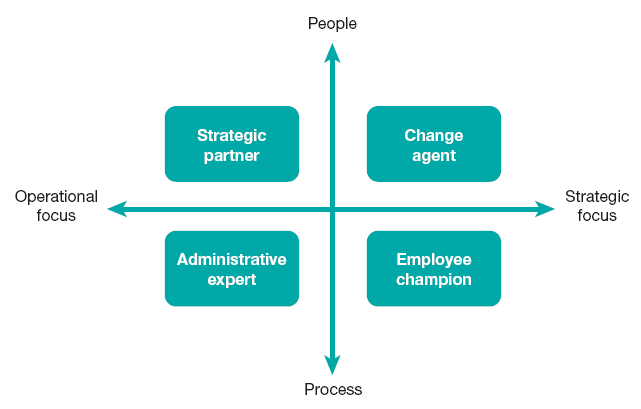
- HR as strategic partner. This long-term, process-oriented role translates business strategy into organisational and workforce priorities. HR helps shape capabilities, operating models and measures, and must understand how the organisation creates value rather than merely cascade corporate targets into an HR scorecard.
- HR as administrative expert. This short-term, process-oriented role delivers dependable, efficient and compliant employee services across entry, movement and exit. It requires sound controls, current knowledge of employment requirements, accessible service design and responsible use of technology and data.
- HR as employee champion. This short-term, people-oriented role listens to employees, strengthens engagement and capability, and helps maintain a fair employment relationship. Credibility depends on relational skill, confidentiality boundaries, procedural fairness and clarity that HR ultimately acts on behalf of the organisation rather than as independent employee counsel.
- HR as change agent. This long-term, people-oriented role builds the organisation’s capacity to adapt. HR supports leaders and employees in diagnosing culture, designing change, developing capability and sustaining new ways of working. It requires knowledge of strategy, the organisation, culture and evidence-based change practice.
Origins
Dave Ulrich set out the four-role framework in Human Resource Champions in the mid-nineties. He argued that HR should be judged by outcomes and value delivered, not by an inventory of activities. Crossing strategic and operational focus with process and people orientation produced the strategic partner, administrative expert, employee champion and change-agent roles. The framework strongly influenced HR operating-model design and the later business-partner concept, although subsequent formulations have evolved beyond the original matrix.
What it is
- Strategic partner
- Administrative expert
- Employee champion
- Change agent.
These are contributions to be delivered, not necessarily four job titles or separate teams. An effective HR function can perform each role when the context requires it and can make ownership, service standards and escalation routes clear.
How to use it
Begin with the organisation’s strategy, workforce risks, employee needs and mandatory obligations. Ask internal stakeholders what outcomes they require from HR, then map current services and capabilities to the four roles. Identify where a contribution is missing, duplicated, under-resourced or measured only by activity. Agree outcomes, decision rights and service interfaces with managers and employees.
Use the gaps to set a development agenda for skills, capacity, structure, data and technology. Decide which work belongs in shared services, specialist centres, business-facing roles or line management, without assuming one architecture fits every organisation. Review the balance regularly as strategy, regulation and workforce expectations change.
Final analysis
The model exposes but does not resolve HR’s dual responsibility to the organisation and its employees. HR may implement management decisions, enforce policy and also ask employees to raise sensitive concerns. Trust requires transparent confidentiality limits, independent reporting routes where appropriate, consistent procedure and visible willingness to challenge unlawful, unsafe or unfair decisions.
A second risk is turning the strategic-partner role into a status hierarchy. Strategic access has little value if payroll, employee relations or change delivery are unreliable. The required balance should follow organisational and workforce needs, not HR’s aspiration for proximity to senior leaders. Capability across roles matters more than declaring one role superior.
Top practical tip
Define each role through a stakeholder outcome and evidence of value. This makes gaps and trade-offs clearer than assigning broad labels to teams or job titles.
Top pitfall
Do not use the employee-champion label to imply that HR is independent counsel. State whose interests HR represents, its confidentiality limits and the protected alternatives available to employees.
Further reading
Ulrich, D. (1996) Human Resource Champions. Cambridge MA: Harvard Business School Press.
Ulrich, D., Allen, J., Brockbank, W., Younger, J. and Nyman, M. (2009) HR Transformation: Building HR Resources from the Outside In. New York: McGraw-Hill.