 keymodels
Disruptive innovation
When and how should disruptive innovation be applied?
Contents
Introduced by Joseph Bowyer and Clayton Christenson in their 1995 article, a disruptive innovation is an innovation that leads to a product or service designed for a.
Joseph L. Bower and Clayton M. Christensen introduced the theory behind disruptive innovation in their 1995 article “Disruptive Technologies: Catching the Wave.” A disruption begins with a business model that serves overlooked low-end customers or enables new customers to participate, then improves until it can challenge established providers in the mainstream market.
When to use it
Use the theory to examine how a well-managed incumbent can still be displaced. Established firms often see the emerging technology, but their customers, margins, processes and resource-allocation rules make the early opportunity unattractive. A start-up with a different cost structure and value network can pursue it.
Two principal patterns are:
- Low-end disruption. The entrant serves overserved, price-sensitive customers with a simpler, more affordable offer. Incumbents may willingly retreat because the segment is less profitable. The entrant then improves and moves upmarket while preserving a cost or business-model advantage.
- New-market disruption. The entrant makes consumption possible for people who previously lacked the money, skill, access or convenience required by existing solutions. Growth comes from non-consumption before the offer competes directly with incumbents.
A radical or successful innovation is not automatically disruptive. The path through an overlooked foothold and subsequent movement toward the mainstream is essential to the theory.
Origins
Bower and Christensen published the core argument in 1995. Christensen developed it further in The Innovator’s Dilemma, explaining why rational investment in the needs of an incumbent’s best customers can cause the organisation to miss a smaller, initially inferior-looking market. Later work refined the distinction between low-end and new-market footholds and emphasised the enabling business model rather than technology alone.
What it is
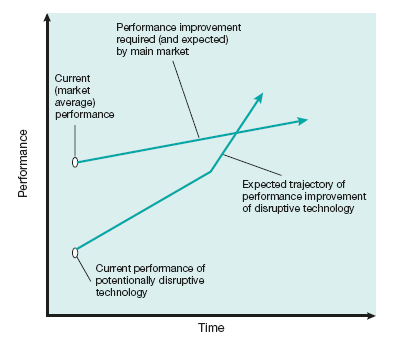
The diagram contrasts the performance customers can use with the trajectories of sustaining improvement and an entrant that begins below mainstream requirements. As the entrant improves, it becomes “good enough” for progressively more demanding customers.
How to use it
Assess a candidate by tracing its market path, not by asking whether the technology seems dramatic.
- Determine whether the innovation is sustaining or begins in a genuine low-end or new-market foothold.
- Explain its strategic significance and the conditions under which it could move toward the mainstream.
- Locate customers who value its simplicity, affordability or new accessibility.
- Give an appropriately structured organisation responsibility for building the business.
- Protect that unit from mainstream targets and processes that would force it to abandon the foothold too early, while maintaining deliberate governance and shared learning.
An independent unit is not an end in itself. Its resources, processes, profit model and priorities must fit the emerging market, and reintegration should be considered only when the economics and operating requirements become compatible.
Final analysis
Disruptive innovation is most reliable as an explanation of trajectories and organisational incentives, not as a label for every breakthrough or as a certain prediction. Similar to Moore’s law—the observation that transistor density on integrated circuits roughly doubled every 2 years—the pattern can guide attention without removing uncertainty.
Managers rarely know in advance which entrant will become disruptive, how rapidly performance will improve or whether mainstream demand will shift. Customer adoption depends on price, complements, standards, distribution and trust as well as technical performance. Combining trajectory analysis with market experiments and an appropriate diffusion model can provide a more complete view.
Top practical tip
Look for non-consumption or overserved customers and examine whether a different business model can serve them profitably. Track the entrant’s improving ability to meet mainstream jobs rather than relying on the excitement surrounding its technology.
Top pitfall
Do not call an innovation disruptive merely because it is novel, digital, cheap or successful. Without an overlooked foothold and an upward market trajectory, the concept is being used as a synonym rather than as a testable theory.
Further reading
Bowyer, J.L and Christensen, C.M. (1995) ‘Disruptive technologies: catching the wave’. Harvard Business Review 73(1), 43–53.
Christensen, C.M. (1997) The Innovators Dilemma: When New Technologies Cause Great Firms to Fail. Boston, MA: Harvard Business School Press.
Leifer, R., McDermott, C.M., O’Connor, C.G., Peters, L. S., Rice, M.P. and Veryzer, R.W. (2000) Radical Innovation: How Mature Companies Can Outsmart Upstarts. Boston, MA: Harvard Business School Press.