 keymodels
Innovation circle
When and how should innovation circle be applied?
Contents
The innovation circle is a model for efficiently analysing and successively managing the life cycle of a new innovation.
The innovation circle manages an innovation from the stimuli that generate ideas through development, launch, operational delivery and eventual renewal. Its central insight is that exploration, implementation and commercial operation require different management disciplines.
When to use it
Use the circle to create an end-to-end view of a product, service or process innovation, clarify handoffs and prevent teams from treating launch as the end of innovation management. It is particularly helpful when creative work and operational integration are disconnected.
Origins
The innovation circle is a practical synthesis rather than a model with one documented inventor. It draws on new-product development, diffusion and operations management. Its closest established relative is Robert G. Cooper’s Stage-Gate approach, developed from research into new-product success in the late twentieth century. The circle places more emphasis on capitalisation, service and the way one lifecycle stimulates another.
What it is
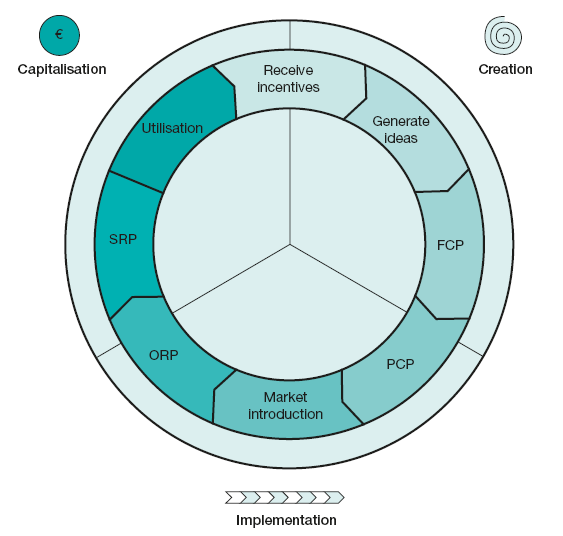
The model has three phases: creation, implementation and capitalisation.
| 1 | The creation phase. Discover and organise the seeds of products, processes and services. | |
|---|---|---|
| (i) | Receive incentives – interpret signals such as slowing growth, weaker brand performance, declining satisfaction, unmet needs or new technology. | |
| (ii) | Generate ideas – create several responses in an exploratory climate, then assess customer value, return, risk and resources before selecting ideas to develop. | |
| (iii) | Function creation process (FCP) – translate the selected idea into customer and system functions, assumptions and controllable risks. | |
| 2 | The implementation phase. Develop the concept and prepare its introduction. | |
| (i) | Product creation process (PCP) – turn functions into specifications, prototypes and tested product or service designs. | |
| (ii) | Market introduction – prepare and execute launch while readying operations for repeatable fulfilment. | |
| 3 | The capitalisation phase. Integrate delivery and manage the innovation’s economic contribution. | |
| (i) | Order realisation process (ORP) – establish reliable production, logistics and order fulfilment, integrated with existing operations where that creates value. | |
| (ii) | Service realisation process (SRP) – embed any new service in support and service-delivery systems. | |
| (iii) | Utilisation – manage revenue, margin, cost and incremental improvements until retirement, then feed learning and unmet needs into the next cycle. |
How to use it
In creation, optimise for learning. Run parallel discovery, involve customers and make assumptions testable. Governance should set ethical, strategic and resource boundaries without demanding the certainty of a delivery project.
In implementation, convert the chosen concept into a controlled programme. Define scope, evidence gates, resources, technical and market tests, launch readiness and stop criteria. Project-management discipline becomes more appropriate because the intended functions are clearer.
In capitalisation, integrate the innovation into routine operations. Establish quality, capacity, supply, service, commercial and performance ownership. Monitor whether the offer creates customer and enterprise value, and decide when to improve, scale, reposition or retire it.
Use explicit transition criteria between phases, but allow evidence to send work backward. The circle is not permission to keep every idea alive. Portfolio choices and termination decisions protect resources for stronger opportunities.
Final analysis
Like Stage-Gate, the model makes innovation manageable by distinguishing stages and decisions. It differs by giving operational integration and commercial return a full phase and by depicting renewal after the end of a lifecycle.
Its simplicity is also a limitation. Real innovation is iterative, may involve regulation or ecosystem partners, and rarely follows a clean sequence. Adapt the circle and preserve feedback rather than using it as a ceremonial checklist.
Top practical tip
Set a different dominant objective for each phase: learning in creation, validated delivery in implementation and repeatable value in capitalisation.
Top pitfall
Do not govern every phase identically. Premature certainty suppresses exploration, while prolonged experimentation undermines reliable delivery and commercial return.
Further reading
Cooper, R.G. “Stage-Gate Systems: A New Tool for Managing New Products,” Business Horizons.
Tidd, J. and Bessant, J. Managing Innovation: Integrating Technological, Market and Organizational Change. Hoboken, NJ: Wiley.