 keymodels
Stage-Gate model
How can stage-gate model support strategic choice or positioning?
Contents
An idea-to-launch governance process that alternates cross-functional development stages with evidence-based investment decisions.
The Stage-Gate model, also called Phase-Gate, structures the uncertain journey from an idea to market launch. Teams perform cross-functional work within stages; at the intervening gates, decision-makers assess evidence and choose whether to continue, stop, pause or recycle the project. The framework can govern a new product, technology or process improvement.
When to use it
Use Stage-Gate when an organisation needs one coherent process spanning early investigation, business justification, technical and commercial development, launch and post-launch learning. It is especially valuable when the development pipeline contains more projects than available people or capital can support. Gates create quality-control and portfolio decisions: they test execution, reassess the business rationale and allocate resources so that the organisation concentrates on the right projects and develops them well.
Origins
Phased investment and review processes existed in chemical engineering, industrial development and organisations such as NASA before the contemporary framework. Robert G. Cooper’s research on successful and unsuccessful innovation projects produced the Stage-Gate idea-to-launch process in the mid-1980s. Cooper and Scott J. Edgett subsequently extended its application through research, portfolio methods and consulting practice.
What it is
Stage-Gate separates innovation into stages, where a cross-functional team reduces uncertainty and creates defined deliverables, and gates, where accountable leaders compare those deliverables with agreed criteria. A gate may decide to go, kill, hold or recycle the project. Early stages test opportunity and concept; later work develops, validates, launches and reviews the offer. Investment increases as evidence and confidence grow. The model filters uncertainty—it does not promise that every surviving idea will succeed.
How to use it
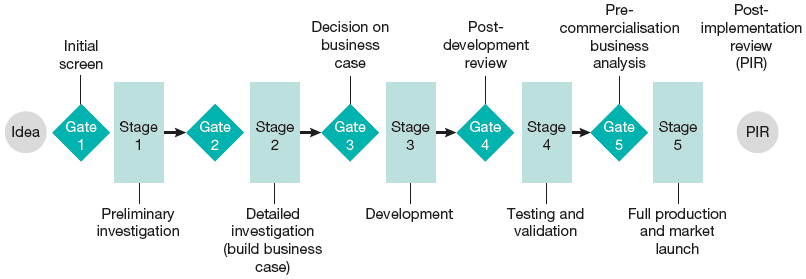
A generic design uses five stages and five gates, preceded by a discovery or ideation period. Discovery produces a possible product or technology. The initial screen tests whether the idea fits the intended market position, strategy and portfolio. If it passes, the organisation defines a project and moves through:
- Scoping – frame the opportunity, initial justification and proposed development plan. Describe likely applications, target customers and benefits.
- Build business case – investigate the market, customer problem, applications and comparative advantage over competitors and substitutes. Demonstrate commercial, technical and operational feasibility and specify the project plan.
- Development – complete detailed design and development. Create the production or operating process and prepare the associated commercial plan.
- Testing and validation – after reviewing proof of concept or prototypes, test the offer and its supporting brand, marketing and operational systems in the laboratory, plant and market as appropriate.
- Launch – after commercial feasibility has been accepted, scale production or service delivery and begin full marketing and sales.
Conduct a post-launch or post-implementation review after the launch stage. Compare results with the business case, capture learning and improve both the offer and the development process.
Final analysis
Stage-Gate can expose problems and weak assumptions before the project absorbs its full cost. Disciplined gates remove poor projects earlier and reduce pipeline congestion.
The framework can incorporate financial valuation such as net present value and technical evidence such as technology readiness levels. Each gate also creates a formal conversation among the project team, executive sponsors and other stakeholders about progress, risk and continued strategic importance.
Its main weakness is the danger of over-structuring discovery. Innovation is often iterative, particularly in creative and research-intensive work. A rigid linear interpretation may reward polished documentation, suppress experimentation and delay learning. Tailor the evidence, path and gate cadence to the uncertainty of the project while retaining clear investment accountability.
Top practical tip
Define the decision, criteria, required evidence and decision owner for every gate before the project reaches it.
Top pitfall
Do not turn gates into document approvals that automatically continue sunk-cost projects. Preserve genuine go, kill, hold and recycle choices, and adapt the route when learning changes the concept.
Further reading
Cooper, R.G., Edgett, S.J. and Kleinschmidt, E.J. (2002) Portfolio Management for New Products. Reading: Perseus Books
Cooper, R.G. (2011) Winning at New Products: Creating Value through Innovation, 3rd edn. Basic Books.
European Industrial Research Management Association (EIRMA) (2002) No. 59: Project Portfolio Management. Paris: EIRMA.
Stage-Gate International: www.stage-gate.com