 keymodels
SWOT analysis
How can swot analysis support strategic choice or positioning?
Contents
Any company undertaking strategic planning must at some point assess its strengths and weaknesses.
Strategic planning requires an honest view of what an organisation can do well, where it is vulnerable and how its environment is changing. A SWOT analysis—also presented in a reversed form as TOWS—brings those observations together as strengths, weaknesses, opportunities and threats.
When to use it
Use SWOT to connect internal resources and capabilities with the competitive conditions around the organisation. It can support the development and selection of strategy, or any other decision for which the objective and scope have first been defined clearly.
Origins
SWOT grew out of post-war corporate-planning practice, not from a single, securely documented invention. Stanford Research Institute planners used the earlier SOFT categories—satisfactory, opportunity, fault and threat—while Harvard business-policy teaching examined the fit between internal strengths and weaknesses and external opportunities and threats. Those strands converged into the familiar SWOT label and matrix. The often-repeated attribution to Albert Humphrey alone is not supported by a definitive contemporary record.
What it is
How to use it
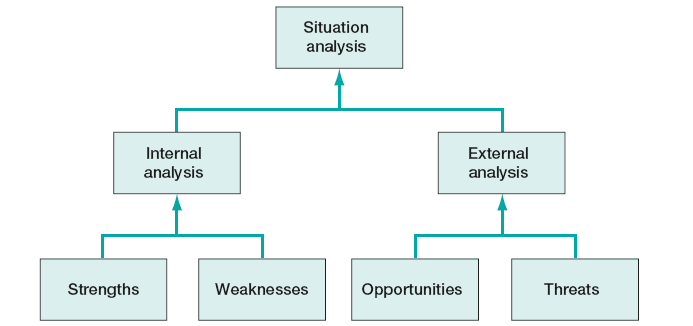
Begin by defining the decision to be made, then scan both the organisation and its environment. Strengths and weaknesses are internal: they are the assets, skills, systems and limitations that improve or weaken the organisation’s position relative to competitors. Opportunities and threats are external: they arise from market movements, competitor behaviour and wider environmental change rather than from the organisation itself.
- Strengths. Ask what the organisation does particularly well. Relevant evidence might include an experienced sales force, favourable access to raw materials, a trusted brand or a strong reputation. A growing market is not a strength, because it exists outside the company; it is an opportunity.
- Weaknesses. Identify missing capabilities and activities performed poorly. A weakness is not simply the inverse of a threat, and lacking a particular capability is not necessarily a competitive disadvantage if actual and potential rivals lack it too.
Support claims about strengths and weaknesses with an internal review, an independent audit or benchmarking. Search for opportunities and threats in macro forces—demographic, economic, technological, political, legal, social and cultural—as well as in industry forces involving customers, competitors, channels and suppliers.
- Opportunities. Look for developments the organisation could exploit: technological or demographic shifts, partnership-led demand, entry into new markets, or the licensing and sale of intellectual property. Treat these as hypotheses until detailed market analysis establishes that they are real and accessible.
- Threats. Consider how regulation, substitute technologies and changes in the competitive field could harm performance. Consequences can include lower sales, higher operating or financing costs, failure to break even, compressed margins and returns below market expectations. An opportunity for one company may be a threat to another.
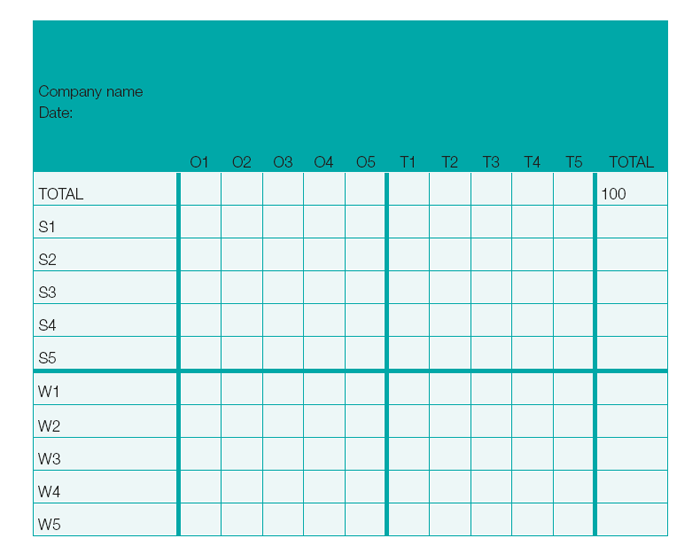
Transfer the strongest evidence from the internal and external reviews into a confrontation matrix. Pair strengths and weaknesses with opportunities and threats, then score each combination according to its significance. The highest-priority intersections reveal the strategic issues that most urgently require attention.
Next, translate the diagnosis into choices. Decide whether to use existing strengths to capture opportunities, acquire capabilities needed to pursue them, employ strengths to counter threats, or reduce weaknesses and exposure.
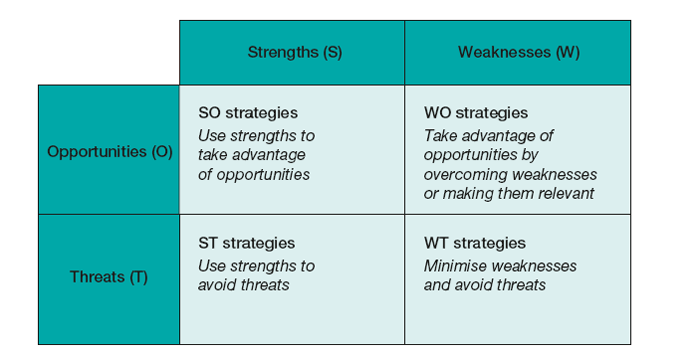
‘SO’ and ‘WT’ positions are the most intuitive: exploit an opportunity with a genuine strength, and avoid a contest for which the organisation lacks the required competence. ‘WO’ choices carry greater execution risk because the opportunity exists before the necessary capability does. In that case, the organisation must:
- build the required strength;
- buy, partner for or otherwise borrow it; or
- compensate by outmanoeuvring competitors.
‘ST’ strategies use an established strength to withstand or reshape a threat. Large competitors, for example, may rely on price wars, marketing expenditure or coordinated channel promotions to repel smaller entrants. Scenario planning can help the organisation anticipate such threats before committing to a response.
The steps in the commonly used three-phase SWOT analysis process.
Phase 1: Detect strategic issues
- Identify the industry and wider environmental issues that affect strategic position, recognising that management cannot directly control external opportunities and threats.
- Identify the internal conditions that shape the firm’s strategic position.
- Assess and rank external issues by likelihood and potential impact.
- Record in the SWOT matrix the internal and external issues most likely to shape the organisation’s long-term competitive position.
Phase 2: Determine the strategy
| 5 | Evaluate the fit between the firm’s internal capabilities and its external environment. | |
|---|---|---|
| 6 | Develop alternative strategies for the most important issues. | |
| 7 | Assign each alternative to its appropriate quadrant in the SWOT matrix: | |
| (i) | SO – combine internal strengths with external opportunities, while considering whether those strengths can compensate for weaker areas; | |
| (ii) | WO – compare the value of an opportunity with the investment required to buy or develop the missing internal capability; | |
| (iii) | ST – use internal strengths against external threats and assess whether adaptation could convert the threat into an opportunity; | |
| (iv) | WT – treat the combination of internal weakness and external threat as the most exposed position; major change, including divestment, may be necessary. | |
| 8 | Create additional options for any blind spots left in the matrix. | |
| 9 | Choose the strategy that best fits the evidence and objective. |
Phase 3: Implement and monitor strategy
| 10 | Turn the selected SWOT strategy into an implementation plan. |
|---|---|
| 11 | Allocate ownership and budgets. |
| 12 | Track implementation and results. |
| 13 | Repeat the review as conditions and evidence change. |
Final analysis
SWOT is a useful management self-assessment, but its simple labels conceal difficult judgements. Teams must distinguish evidence from opinion, identify genuine relative strengths and weaknesses, and estimate both the likelihood and impact of external developments. The matrix itself provides little guidance for converting classifications into strategic alternatives. Weak assumptions can therefore produce indecision, delay or a confidently chosen but poorly grounded strategy.
Top practical tip
Define the decision first, then identify and validate the organisation’s strengths, weaknesses, opportunities and threats against that specific objective.
Top pitfall
Do not treat an untested list of opinions as analysis. Unsupported classifications can distort the alternatives and delay a decision.
Further reading
Abell, D.F. and Hammond, J.S. (1979) Strategic Marketing Planning: Problems and Analytical Approaches. Prentice Hall.
Armstrong, J.S. (1982) ‘The value of formal planning for strategic decisions’. Strategic Management Journal 3, 197–211.
Hill, T. and Westbrook, R. (1997) ‘SWOT analysis: It’s time for a product recall’. Long Range Planning 30(1), 46–52.
Menon, A., Bharadwaj S.G., Adidam, P.T. and Edison, S.W. (1999) ‘Antecedents and consequences of marketing strategy making. A model and a test’. Journal of Marketing 63(2), 18–40.
Weihrich, H. (1982) ‘The TOWS matrix, a tool for situational analysis’. Long Range Planning 15(2), 54–66.