 keymodels
The value chain
How can the value chain support strategic choice or positioning?
Contents
According to Porter (1985), competitive advantage can only be understood by looking at the firm as a whole.
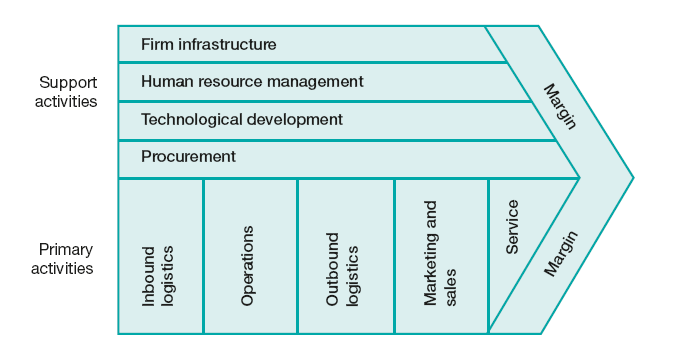
Competitive advantage emerges from the complete system of activities through which a firm creates and delivers customer value. The value chain separates that system into primary and support activities so managers can locate cost, differentiation and coordination advantages.
When to use it
Use the model to diagnose sources of competitive advantage, understand how activities reinforce one another and decide where to reduce cost or increase customer value.
It is also useful for outsourcing and offshoring. Mapping interfaces and dependencies makes a make-or-buy decision more rigorous than comparing the visible cost of one activity in isolation.
Origins
Michael E. Porter introduced the value chain in his 1985 book Competitive Advantage. He designed it to connect strategy with implementation by breaking a company into strategically relevant activities. Porter emphasised linkages among activities and relationships with supplier and customer value chains, not only the performance of each box.
What it is
How to use it
Define the customer and unit of analysis, then decompose work far enough to reveal different cost drivers, capabilities or sources of value. Compare performance and linkages with competitors rather than documenting only the internal process.
Primary activities are:
- Inbound logistics: receiving, handling, storing and scheduling inputs, including supplier and inventory management.
- Operations: transforming inputs through production, assembly, packaging, testing and equipment maintenance.
- Outbound logistics: order processing, storage, transport scheduling and distribution.
- Marketing and sales: creating awareness, explaining benefits, setting price, selecting channels and converting demand.
- Service: installation, training, maintenance, spare parts and upgrades that preserve or increase value after sale.
Support activities operate across the chain:
- Procurement: sourcing inputs and services, negotiating agreements and securing facilities or capacity.
- Technology development: research, product and process design, automation and service innovation.
- Human-resource management: recruiting, developing, rewarding and retaining the people needed by the activities.
- Firm infrastructure: leadership, planning, finance, accounting, legal, public affairs and quality systems.
For each activity, identify customer contribution, cost, asset use, information and dependencies. The margin comes from the value customers recognise minus the combined cost of the system, not from optimising every activity independently.
Final analysis
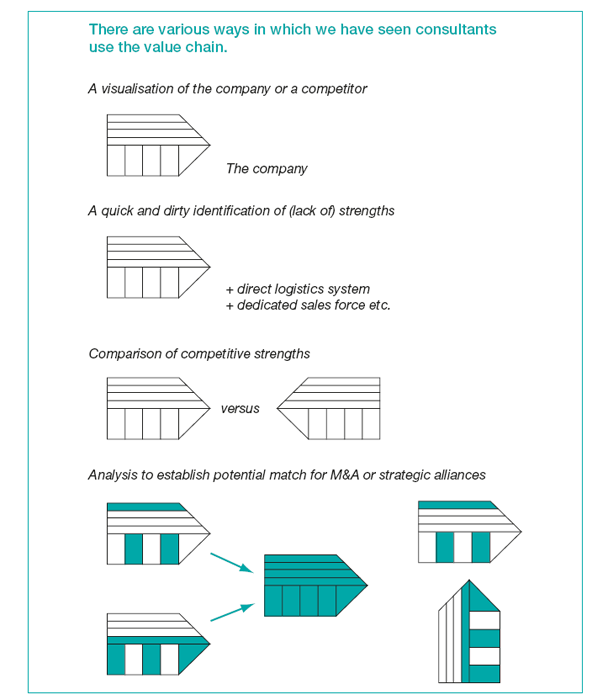
The framework supports capability assessment, alliance design and transaction analysis. Two companies may complement one another—for example, one strong in logistics and the other in sales and service—but integration value depends on whether their activities and systems can actually work together.
Objective ratings are difficult, and exhaustive mapping can become expensive. Focus detail on activities that materially affect customer value, cost or strategic control.
Pil and Holweg’s 2006 ‘value grid’ argument reflects networks in which value moves across multiple suppliers, partners and customers rather than through one linear chain. The original chain remains useful if the analysis includes those external connections.
Top practical tip
Analyse each strategically relevant activity for customer value, cost and linkage effects rather than optimising it in isolation.
Top pitfall
Do not mistake subjective activity ratings or an exhaustive process map for evidence of competitive advantage.
Further reading
Pil, F.K. and M. Holweg (2006) ‘Evolving from value chain to value grid’. MIT Sloan Management Review 47(4), 72–79.
Porter, M.E. (1985) Competitive Advantage: Creating and Sustaining Superior Performance. New York: Free Press.